Worried your home station will sound hollow or noisy? The best microphone for internet radio broadcasting is usually a cardioid dynamic mic, used close to your mouth. USB suits beginners; XLR gives room to grow.
This guide belongs to the wider topic of internet radio equipment, and it focuses on the first link in your signal chain: the microphone.
| Item | Value |
|---|---|
| Shure MV7+ (USB/XLR dynamic) | $279 MSRP |
| Shure SM7B (XLR dynamic) | From $399 |
| Earthworks ETHOS (XLR condenser) | $400 in a March 2022 review, plus a $100+ XLR interface |
| Rode PodMic (XLR dynamic) | $100 in a March 2022 review |
| Audio-Technica ATR2100x-USB (USB and XLR dynamic) | $100 in a March 2022 review |
| Suggested mouth-to-mic distance | Two to 12 inches |
The prices and distance come from Shure’s podcasting guide and Marco Arment’s podcasting microphone review, whose figures date from his March 2022 update. Prices can change, so check the source before you rely on them.
USB or XLR: which connection suits your station?
The first choice is the connection. According to Adorama’s buying guide, a USB microphone plugs directly into your computer and has its own gain control, while an XLR microphone needs an audio interface.
USB keeps things simple for a solo presenter. MusicRadar’s guide notes that a premium XLR mic suits an established studio but is awkward without an interface, whereas a plain USB mic covers what one host needs.
A hybrid mic lets you start simple and grow later. The Shure MV7+ offers USB-C and XLR outputs and lists at $279 MSRP on Shure’s podcasting page, and it was MusicRadar’s top pick overall as of its 22 October 2026 update.
When you outgrow a single USB mic, the guide to the best audio interface for streaming radio explains what to plug an XLR microphone into.
Dynamic or condenser for a home studio
Most home stations have no acoustic treatment, which favours a dynamic microphone. Shure says dynamic mics naturally mask air-vent hiss and mouth noises, much as a soft-focus filter hides blemishes on camera.
A condenser is more sensitive and sounds crisp, but that same detail is the risk. Shure warns it can pick up too much vent noise plus lip and tongue sounds, and Adorama adds that condensers want a stand with a shock mount for the best results.
Dynamics have one quirk, the proximity effect. Adorama explains that the closer the mic sits to your mouth, the more low end it picks up, which flatters some voices and needs cleanup on others.
Features that matter for speech
A good radio mic is about controlling noise, not chasing the fanciest spec sheet. Shure’s guide points to a handful of traits worth checking:
- Cardioid pickup: it is less sensitive to sound from the sides and back, which reduces room noise and reflections.
- Pop control: foam inside the mic or an external screen stops plosives, and nothing sounds more amateur than a pop on the word “professional”.
- Shock mounting: it filters vibrations from touching the table or typing while the mic is live.
- High-pass filter: a switch on the mic or mixer adds protection from thumps and bumps and trims low-frequency room noise.
- Tone control: switches or onboard processing help you flatter your voice and play down your room.
Tighter patterns such as supercardioid reject more noise, but they demand that your mouth stays on target. That is harder for most people than it sounds, so cardioid is the safer default.
Microphones worth comparing
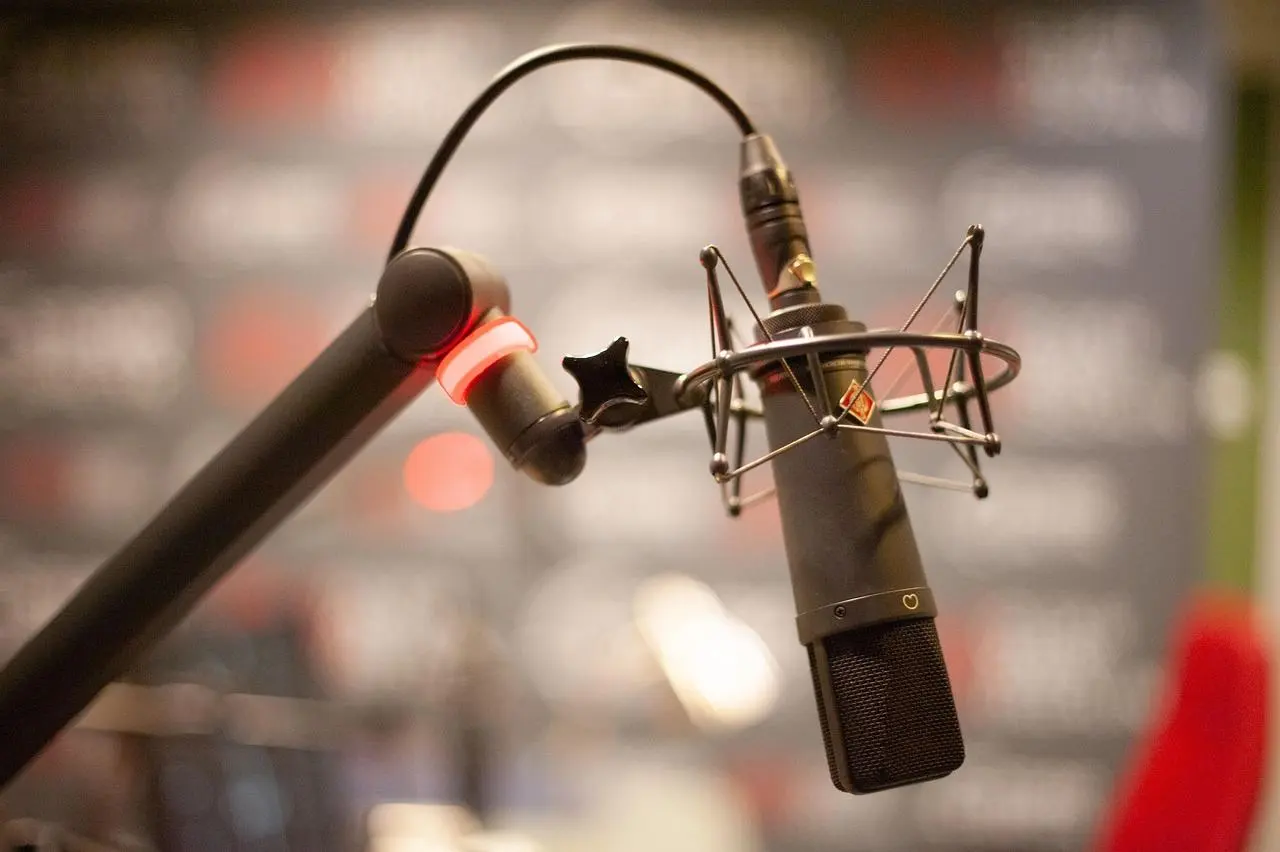
These models appear across the reviews we checked, listed from hybrid to specialist. Treat the list as a starting point rather than a ranking.
- Shure MV7+: a hybrid USB/XLR dynamic with an onboard processor, priced at $279 MSRP according to Shure.
- Shure SM7B: from $399, and per Shure a long-time fixture in radio stations that wants you within two or three inches.
- Earthworks ETHOS: Marco Arment priced it at $400 and called it the best all-around podcast mic he had found, with built-in shock mounting and pop filtering.
- Electro-Voice RE20: Marco Arment priced it at $450 and describes it as an all-arounder that forgives sloppy mic technique.
- Rode PodMic: at $100 in that review, a compact dynamic with a built-in mount and pop filter, made as a cheaper alternative to the SM7B.
- Audio-Technica ATR2100x-USB: also $100 in the same review, with USB and XLR outputs, but you must speak closely to it.
- SE Electronics V7: Adorama calls it arguably the best handheld podcast mic under $100.
The review prices are from March 2022, so expect street prices to differ today. Verify them with a retailer before you buy.
Room and technique matter as much as the mic
Even an excellent microphone cannot rescue a bad room. Shure says professional sound needs a good room as well as a good mic, and that moving the mic within two to 12 inches of your mouth makes your voice louder than the noise and reflections.
Low-output dynamics ask more of your preamp. Shure says the SM7B has a fairly low output and needs a good interface or signal booster, while Marco Arment notes the RE20 needs a powerful preamp, though less than the SM7B does.
Think about the listener too. Your audience compares your sound with other radio and broadcast output, so any hum, echo or pop stands out, and the best internet radio receivers are a useful reference for how your stream may be heard.
Frequently asked questions
Is a USB microphone good enough for an internet radio show?
Show answer
Yes, for a solo host it usually is. It plugs in and works, and a hybrid model lets you move to XLR later if you add a mixer or more guests.
Do I need a pop filter or a shock mount?
Show answer
Plosives and desk thumps are the usual problems. Foam inside the mic or an external screen tames pops, and a shock mount filters the vibrations that travel through a desk, as Shure describes.
How close should I sit to the microphone?
Show answer
For general speech, Shure suggests a span of two to 12 inches. The SM7B asks for a tighter distance of two or three inches, and sitting closer also lifts your voice above room noise.
Which budget microphone is a safe start?
Show answer
Marco Arment found the Audio-Technica ATR2100x-USB, at $100, a very good value if you speak up close to it. For handheld use, Adorama points to the SE Electronics V7 at under $100.